
A new report has found “clear human rights failures” across the south of Scotland with basic obligations on food, health and housing not being met.
The study was carried out over eight different local authority areas which are home to more than a million people.
The Scottish Human Rights Commission (SHRC) concluded that the biggest challenge was accessibility as, even if services did exist, they were often unreachable in practice.
Deputy First Minister Jenny Gilruth said the Scottish government already offered free transport for a range of groups, while public service reform represented an opportunity to “push power out” to communities around the country.
In February and March, the SHRC visited communities including Stranraer, Ayr, Dumfries, Kilmarnock, Hamilton, Irvine, Arran, Galashiels, Kelso, Dalkeith, Haddington, Melrose, Ardrossan and Tranent.
“Overall, the south of Scotland is a region where many communities and duty bearers are working hard to protect dignity and their human rights, often in difficult circumstances,” its report concluded.
“But we have also found clear human rights failures.
“In many areas, rights are not improving. In several areas, they are getting worse.”
Prof Angela O’Hagan, who chairs the commission, said the report highlighted the “gaps” between rights everyone was entitled to and the “lived reality” in southern Scotland.
She said it was “call to action” for everyone who managed and delivered services with people in the area feeling “distant from decision making”.
The report includes a string of case studies which highlight areas of concern, such as the variation of service provision depending on where people live.
Donald worked as landscape gardener before suffering from a stroke and later contracting Lyme disease after being bitten by a tick.
He said a locum neurologist referred him to a specialist clinic in another south of Scotland health board, but he was rejected because he didn’t live in the right area.
“We don’t have a national health service, we’ve got a regional health service,” he said.
“I’m just left in limbo, unable to work and unable to get better, even though I know there’s a solution out there.”
Another section of the report highlighted the plight of one woman trying to find the right health care for her husband.
But she found navigating services for the former soldier to be “impossible”.
“He was trapped in the health care system here, and he became suicidal,” she added.
“He stood on the front line to protect everybody else’s rights, and nobody would help him.”
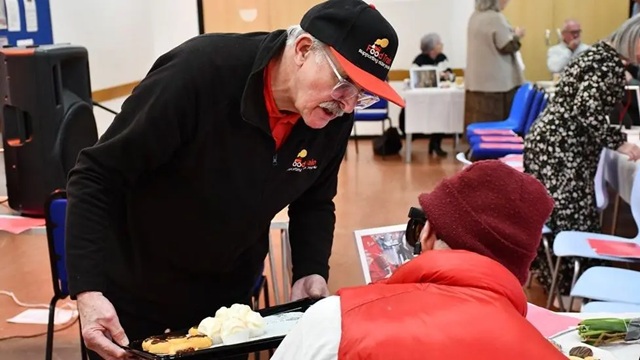
The report also found many households were cutting back on meals and relying on food banks amid rising costs and low incomes.
Meanwhile, one charity service manager told the SHRC: “You have got villages dotted around who don’t get the support they should.
“There’s a big disparity between the town and rural areas which needs to be addressed.
“It shouldn’t matter where you are.”

Janice Johnstone recently contacted the BBC to highlight the difficulties facing people in Dumfries and Galloway getting wheelchair accessible taxis
The issue of accessibility to services is one which has been regularly raised in southern Scotland.
Wheelchair user Janice Johnstone recently highlighted the difficulties faced in finding an accessible taxi with only three available in Dumfries and Galloway.
The 70-mile journey facing expectant mothers in Wigtownshire to get to services in Dumfries is also the subject of a long-running campaign and a nationwide review of provision is now under way.
Residents of Newcastleton have also spoken of how the extension of the Borders Railway to stop in their village could be “life-changing”.
A feasibility study is currently looking at ways to take that forward.
And Dumfries and Galloway Council had to step in last year after bus operator Stagecoach effectively quit the region.

Jenny Gilruth said the issues highlighted were felt in many parts of the country and public service reform could help “push power out” to communities
During a visit to Dumfries this week, Gilruth said part of the issue of people feeling distant from government was about geography, which was a “matter of fact”.
However, she said public service reform was a chance to give more power to communities.
“We’ve got a new prime minister coming into power with a devolution agenda, so we expect further powers to flow back to Scotland and with that commensurate funding,” she said.
“But we then as a parliament, as a government, have an opportunity to work on how we push that power out of Edinburgh and down into our communities.”
Economic potential
The deputy first minister said that was an issue across Scotland with people even feeling disconnected from parts of their own region.
Gilruth agreed that transport was “challenging” in the area but added that the government already funded bus travel for under 22s, over 60s and those with disabilities.
“There are other issues in this part of the world around about some of these bus routes simply not existing anymore,” she added.
She said there were powers available to allow local government to franchise and take on their own approaches and said those opportunities needed to be looked at.
During her visit, she highlighted the number of projects with the potential to boost the economy.
She also discussed the unique challenges facing the region in terms of connectivity and how that affected education, health and housing.
Source: bbc.co.uk


Be the first to comment